Karedoks: A Practical Evaluation of Japanese-Inspired Typography for Modern Design
In the crowded landscape of digital and print typography, finding a typeface that balances cultural aesthetic with functional versatility is often a challenge. Karedoks has emerged as a notable option for designers seeking a font with a distinct touch of Japanese style without sacrificing legibility or modern appeal. Unlike generic decorative fonts that rely on heavy ornamentation, Karedoks integrates structural elements reminiscent of East Asian calligraphy into a contemporary framework. This article explores the specific characteristics of Karedoks, evaluates its performance across various media, and compares it against broader typographic categories to help you determine if it fits your specific project requirements.
The Distinctive Character of Karedoks
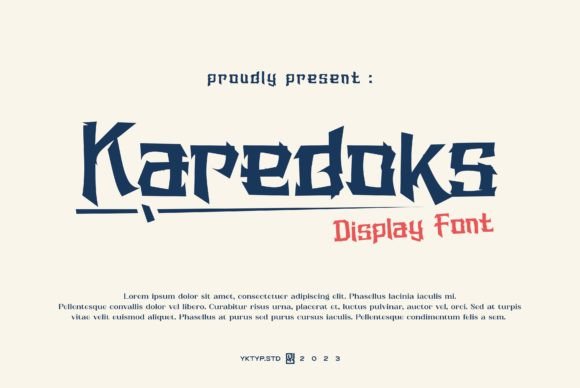
To understand where Karedoks fits in a design workflow, one must first examine what sets it apart from standard sans-serif or serif families. The font is engineered to evoke the visual rhythm of Japanese characters—specifically the interplay between thick and thin strokes and the angular precision found in Kanji and Kana—while remaining fully compatible with the Latin alphabet. This fusion creates a unique visual identity that feels both exotic and familiar to Western audiences.
The primary distinction of Karedoks lies in its stroke modulation. Many "Asian-style" fonts attempt to mimic brush strokes so heavily that they become illegible at small sizes or difficult to kern effectively. Karedoks avoids this pitfall by maintaining consistent x-heights and open counters, ensuring readability even in body text scenarios, though it excels primarily as a display typeface. The geometry of the letters often features sharp terminals and subtle asymmetries that suggest hand-crafted origins without requiring actual hand-lettering. For brands looking to signal creativity, global awareness, or an appreciation for minimalist aesthetics, these nuances provide a sophisticated layer of meaning that standard geometric fonts lack.
Comparing Karedoks to Traditional Display Fonts
When evaluating Karedoks against traditional display fonts, the trade-offs become apparent. Standard display fonts, such as bold slab serifs or wide grotesques, offer high impact but often lack cultural specificity. They are safe choices for general headlines but can feel generic when a project demands a specific mood. In contrast, Karedoks introduces a narrative element through its stylistic cues. However, this comes with a limitation: the font's strong personality means it competes with other visual elements more aggressively than neutral typefaces.
If your design relies on complex backgrounds or dense imagery, a neutral font might allow the content to breathe better. Karedoks, with its distinctive shapes, acts as a focal point. Therefore, it is best utilized when the typography itself needs to carry significant visual weight. Comparing it to script fonts, which also offer personality, Karedoks provides a more structured alternative. While scripts can be charming, they often suffer from poor scalability and legibility issues in all-caps settings. Karedoks retains its integrity across different weights and orientations, making it a more robust choice for logos and packaging where consistency is paramount.
Evaluating Use Cases: Where Karedoks Excels
The versatility of Karedoks extends across a wide range of applications, from digital interfaces to physical merchandise. Its adaptability makes it a strong contender for projects that require a bridge between modern minimalism and cultural depth. Below are the scenarios where Karedoks typically outperforms other options.
- Posters and Banners: The font's bold presence ensures high visibility from a distance. The Japanese-inspired angles create dynamic lines that guide the viewer's eye, making it ideal for event promotions, film titles, and exhibition signage.
- Clothing and Merchandise: On apparel, typography often serves as the graphic element. Karedoks works exceptionally well on t-shirts, hoodies, and tote bags because its clean lines translate perfectly onto fabric without losing detail during the printing process.
- Packaging and Labels: For products ranging from cosmetics to gourmet foods, Karedoks offers a premium look. It suggests quality and attention to detail, which is crucial for consumer goods competing on shelf appeal.
- Digital Media and Logos: In web design and app interfaces, Karedoks functions well as a header font. Its unique character helps a brand stand out in search results and social media feeds, provided it is paired with a highly readable secondary font for body copy.
Limitations and Trade-Offs
While Karedoks is powerful, it is not a universal solution. Designers must recognize situations where this font may hinder communication rather than enhance it. The most significant limitation is its suitability for long-form reading. Due to its stylized nature, using Karedoks for paragraphs of text can lead to reader fatigue. The irregularities that make it attractive in headlines can disrupt the flow of information in articles or manuals.
Furthermore, while the font mimics Japanese aesthetics, it is not a substitute for authentic Japanese typesetting. If a project requires genuine bilingual support (Latin and Japanese characters), Karedoks may not offer the full glyph set required for professional localization. In such cases, a dedicated multilingual font family would be a more appropriate choice. Additionally, the "exotic" feel of Karedoks might clash with brands that prioritize strict corporate neutrality or traditional conservatism. It is essential to align the font's personality with the brand voice; a mismatch here can result in a disjointed user experience.
Decision Factors: Choosing Between Karedoks and Alternatives
Selecting the right typeface involves weighing several factors, including audience perception, medium constraints, and brand alignment. When comparing Karedoks to alternatives, consider the following decision matrix to guide your evaluation.
- Audience Expectations: Does your target demographic appreciate avant-garde or culturally inspired design? If your audience skews towards traditional industries like finance or law, Karedoks might feel too informal. Conversely, for lifestyle, entertainment, or creative sectors, it resonates strongly.
- Scalability Needs: Will the design appear on a business card or a billboard? Karedoks scales well, but extreme reduction can obscure its finer details. If micro-legibility is critical, test the font at 8pt size before committing.
- Brand Consistency: Does the font complement existing brand assets? Karedoks pairs well with minimalist layouts and ample whitespace. It struggles in cluttered environments where its unique shapes get lost.
- Cost vs. Value: Evaluate whether the licensing cost of Karedoks justifies the visual upgrade over free or built-in system fonts. For high-stakes branding where differentiation is key, the investment often pays off in perceived value.
Strategic Pairing for Maximum Impact
To mitigate the limitations of Karedoks, strategic pairing is essential. The font shines when used in conjunction with a neutral, highly legible sans-serif or serif for body text. This combination allows Karedoks to handle the emotional and attention-grabbing aspects of the design while the partner font manages information delivery. For example, using Karedoks for a magazine cover title and a simple Grotesque for the article text creates a balanced hierarchy that is both engaging and readable.
In digital contexts, this pairing strategy is equally important. Web accessibility standards require clear, readable text. Using Karedoks exclusively for navigation menus or form labels could pose usability issues. Instead, reserve it for hero sections, call-to-action buttons, and section headers where its visual flair enhances the user journey without impeding functionality.
Conclusion on Suitability and Application
Karedoks represents a thoughtful evolution in display typography, offering a bridge between Eastern aesthetic traditions and Western design utility. It is not merely a decorative novelty but a functional tool for designers who need to convey sophistication, creativity, and global perspective. Its strengths lie in its ability to command attention in posters, logos, and packaging while maintaining enough structural integrity for versatile use.
However, its effectiveness depends entirely on context. It is best suited for projects where visual impact is prioritized over dense information density. By understanding its trade-offs—such as limited suitability for body text and the need for careful pairing—designers can leverage Karedoks to create compelling, memorable work. Whether you are designing a film title, a clothing line, or a product label, Karedoks offers a distinct voice that can elevate a project above the generic, provided it is applied with intention and strategic foresight.