Ralltez: A Vibrant Display Font That Demands Careful Application
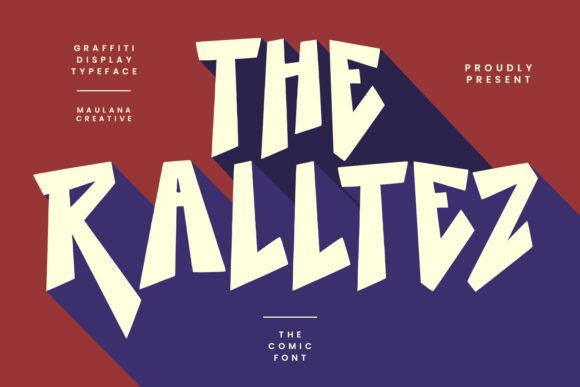
If you are looking to inject a burst of personality into your visual identity, Ralltez is a compelling choice. This font is not merely a collection of letters; it is a character in itself. With its irregular letterforms and whimsical curves, Ralltez exudes an undeniable energy that can transform a static layout into something playful and dynamic. It is the kind of typeface that stops a scroll or grabs attention on a crowded shelf. However, the very qualities that make it so delightful—its quirks and unpredictability—are also what make it prone to misuse. Many designers and content creators assume that because a font looks fun, it is easy to use everywhere. This assumption often leads to designs that feel chaotic rather than creative.
Understanding how to wield Ralltez effectively requires more than just downloading the file and hitting "apply." It demands a strategic approach to typography that balances its inherent playfulness with readability and brand consistency. Whether you are a freelancer crafting a logo for a startup, a marketer designing a campaign poster, or a blogger adding flair to a headline, knowing where this font shines and where it falters is crucial for professional results.
The Allure and Limitations of Irregular Letterforms
People are drawn to Ralltez because it breaks the rigid grid of standard sans-serif or serif fonts. In a digital landscape saturated with clean, minimalist aesthetics, Ralltez offers a human touch. Its irregular shapes mimic hand-drawn elements, suggesting creativity, spontaneity, and warmth. For branding materials targeting younger demographics or industries like entertainment, education, and artisanal goods, this font can be a powerful differentiator.
However, a common misunderstanding is treating display fonts like body text. The irregularity that defines Ralltez makes it difficult to read at small sizes or in long paragraphs. When users attempt to use it for block text, such as website articles, terms and conditions, or detailed product descriptions, the reading experience suffers immediately. The eyes struggle to track the varying widths and curvatures, leading to fatigue and disengagement. This mistake doesn't just look unprofessional; it actively hinders communication. If your audience cannot read your message quickly, the energy of the font becomes a barrier rather than a bridge.
Common Pitfalls in Typography Selection
One of the most frequent errors I see is the "kitchen sink" approach to design. Creators love the vibe of Ralltez and decide to apply it to every element on the page—the main headline, subheadings, buttons, and even captions. This creates visual noise. Without a hierarchy established by contrasting weights and styles, the design loses focus. The viewer's eye has nowhere to rest, resulting in a composition that feels frantic rather than energetic.
Another overlooked detail is the pairing process. Because Ralltez is so dominant, it often clashes with other decorative or heavy fonts. Pairing it with another quirky script or a bold blackletter style usually results in a fight for dominance. The better approach is to let Ralltez do the heavy lifting while supporting it with a neutral, highly legible typeface. Think of Ralltez as the lead actor in a play; it needs a quiet stage crew (the body text) to support the performance without stealing the spotlight.
Strategic Implementation for Maximum Impact
To avoid these pitfalls, you must treat Ralltez as a specialized tool rather than a default setting. Here is how you can integrate it into your workflow effectively:
- Reserve it for headlines and logos: Use Ralltez strictly for short bursts of text. This includes main titles, call-to-action buttons, or single-word emphasis. This ensures the font remains impactful and legible.
- Pair with simple sans-serifs: To maintain readability, pair Ralltez with clean, geometric, or humanist sans-serif fonts. Fonts like Helvetica, Roboto, or Open Sans provide the necessary stability to ground the whimsy of Ralltez.
- Control your spacing: Due to the irregular nature of the characters, automatic kerning often fails. You will likely need to manually adjust the tracking and letter-spacing to ensure the words flow smoothly without awkward gaps or collisions.
- Test across mediums: Before finalizing a design, check how Ralltez renders on different screens and print resolutions. Some of the finer curves may get lost on low-resolution mobile displays or when printed at small sizes.
Consider a real-world scenario: You are designing a flyer for a local music festival. Using Ralltez for the event name and the date/time works perfectly—it screams fun and excitement. However, if you then use the same font for the list of bands, venue address, and ticket prices, the flyer becomes unreadable. By switching the informational text to a crisp, readable font, you preserve the energy of the header while ensuring the practical details are easily consumed.
Evaluating Quality and Licensing Before You Download
Before committing to Ralltez for any project, especially commercial ones, due diligence is essential. The market is flooded with free font downloads, but quality varies wildly. A common mistake is assuming that a font available on a random download site is safe for commercial use. Many of these files lack proper licensing, which can lead to legal issues down the line if a client or business uses the design publicly.
Always verify the license terms. Does the license cover web usage? Can you embed it in a PDF for a client? Is there a limit on the number of impressions? Ignoring these details can cost you money and reputation later. Furthermore, check the completeness of the font family. Does Ralltez come with ligatures, alternate characters, or extended language support? A limited character set can restrict your ability to create unique compositions or work with international audiences.
When evaluating the font's technical quality, pay attention to the curve smoothness and stroke consistency. Even though Ralltez is designed to be irregular, poor vector construction can result in jagged edges or uneven thickness that looks messy rather than intentional. High-quality display fonts maintain a sense of rhythm even within their chaos. If the letters look like they were drawn by an unsteady hand rather than a skilled designer, it might be time to look for alternatives.
Building a Cohesive Visual Language
Ultimately, the goal of using a font like Ralltez is to enhance your message, not obscure it. It should serve your brand's narrative. If your brand is about reliability and precision, Ralltez might send mixed signals unless used very sparingly as an accent. Conversely, if your brand is about innovation, joy, and community, this font can be the cornerstone of your visual identity.
Avoid the temptation to overuse decoration. Just because a font has whimsical curves doesn't mean you need to add extra graphics, drop caps, or textures on top of it. Let the typography breathe. Give it plenty of white space to allow the irregular forms to stand out. Good design is often about subtraction; removing the clutter allows the unique personality of Ralltez to shine through naturally.
By understanding the strengths and limitations of Ralltez, you can make informed decisions that elevate your work. Whether you are a beginner exploring new tools or a seasoned professional refining a brand, treating this font with respect and intentionality will yield results that are both beautiful and functional. Remember, the best typography is invisible in its execution but memorable in its impact. Use Ralltez wisely, and it will bring a delightful touch of creativity to every composition you create.